
1. Transfer what you already know
Let’s take start-up companies for instance. There are certain skill requisites (i.e. marketing skills for customers, coding skills to build the product), resources (i.e. talent, technology), and so on, that determine how successful you can be, and how quickly you can get there.
It’s the same for languages.
Think about what knowledge you already possess. What can be transferred to your target language? This makes learning languages easier, and this explains why Koreans for example find Japanese easier than Arabic.
2. Know the shortcuts
We should always be on the lookout for more effective, and therefore faster ways of learning. Here’s some of these methods:
Cognates
Knowing how to use cognates is a powerful strategy to shorten your learning curve because the words based from your native language can mean the same thing in another language.
For instance, languages from the Latin root such as French, Spanish, Portuguese, Italian, and others have many words in common with English.
Take words such as "action", "distraction", "termination", and thousands of other "-tion" words are spelled exactly the same in French and Spanish. You can quickly get used to the different pronunciation. Change that "-tion" to a "-ció" and "-ción" respectively.
Another example is the similarities of German to English.
"water" becomes "Wasser" (t → s after a vowel)
"chin" becomes "Kinn" (ch → k)
"father" becomes "Vater" (th → t)
Modal verbs
One of the most difficult things you can learn in any language is the conjugations, and knowing how to convert them.
Why not focus on learning how to conjugate the most common modal verbs, that will apply to 80–90% of your sentences during conversations?
To give you a simple example, here’s the 7 most common modal verbs in German.
- können (can)
- wollen (want)
- sollen (should)
- dürfen (may/be allowed to)
- müssen (must)
- möchten (would like)
- mögen (like)
In Spanish, instead of needing to conjugate “ir” — to go by saying:
- Yo voy a tomar [something from the restaurant]
You could easily use the modal verb — “gustaria” — would like:
- Me gustaria [something from the restaurant]
8 sentence structures: I give John the apple
This is a framework used by Tim Ferriss used to deconstruct the most common sentence structures from English to Spanish.
* Keep in mind you can apply this same framework to other languages.
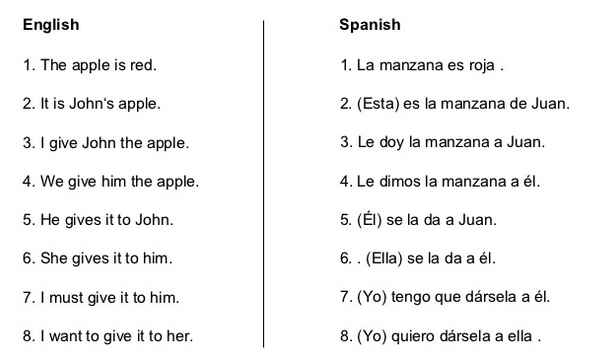
Translating these 8 sentences into the language you want to learn will expose everything from:
- how sentences are structured
- how indirect and direct objects are used (the most painful)
- how to differentiate feminine and masculine words
- how verbs are conjugated into sentences
For example, in English:
The word order is: He/She + verb + (DOP)+ to (IOP).
He gives (verb) the apple (DOP) to her (IOP)
But in Spanish:
The word order is: Él/Ella + (IOP) + (DOP)+ conjugated verb +clarifier.
*IOP=indirect object pronoun
*DOP=direct object pronoun
If you want to read this in further detail, we recommend checking out this article.
3. Speak it
It’s one thing to learn the basics of a language, and another to master it.
There are many of us who may have “studied” a language for years without getting much results. But language cannot be studied. Language is alive. It is used for social interactions and building personal relationships. So speak more. Practice more. Don't be afraid of making mistakes. You would then find yourself improving very quickly.
Now it’s your turn.
How will you be using the resources we shared to reach fluency in your desired language?