

A career change at 40 is not the same problem as a career change at 25. At 25, the problem is addition. You pick a direction, stack experience, build a credential, and wait for it to compound. At 40 or 50, the problem runs the other way. The blocker is not "what do I want to do next." It is what your current life will not fit inside: the income you committed to, the title you answer to, the story you have told everyone about who you are. Before you can credibly pick anything up, you have four things to put down. In order: a story, a credential, a comparison, and a number.
I have changed careers more than once. I left an earlier path to start LifeHack, and a few years ago I rebuilt how I work again, this time around AI. Both times the hard part was not finding the new thing. It was setting down the old version of me that everyone, including me, had gotten used to.
Why a Career Change at 40 Is a Subtraction Problem, Not an Addition Problem
Most career-change advice is written for 25-year-olds and quietly handed to 45-year-olds. It tells you to add: take the course, build the portfolio, network harder, acquire the new skill. That advice is not wrong. It is just answering a question you have mostly already solved. By 40 you usually have plenty. Plenty of skill, plenty of contacts, plenty of evidence that you can learn hard things. What you do not have is room.
The honest version of the problem sounds like the lines we hear most from people in this spot: "I have everything I said I wanted, and I do not recognize myself." Or, flatter and more final: "The career that paid for everything no longer fits who I am." Neither of those is a skills gap. They are a fit problem, and you do not fix a fit problem by adding more.
It helps to know the slower pace is normal, not a personal failure. Older workers move on the job market less often than younger ones: about 17% of workers ages 50 to 64 say they are likely to look for a new job in the near term, against 30% of workers under 30. [1] A full career move is a heavier lift than a job hunt, and heavier still once a mortgage, a title, and twenty years of identity are attached to it. So the lower number is not older workers giving up. It is the weight of what has to be set down first, and setting it down is the actual work.
At 25, the problem is addition. At 40, the problem is subtraction.
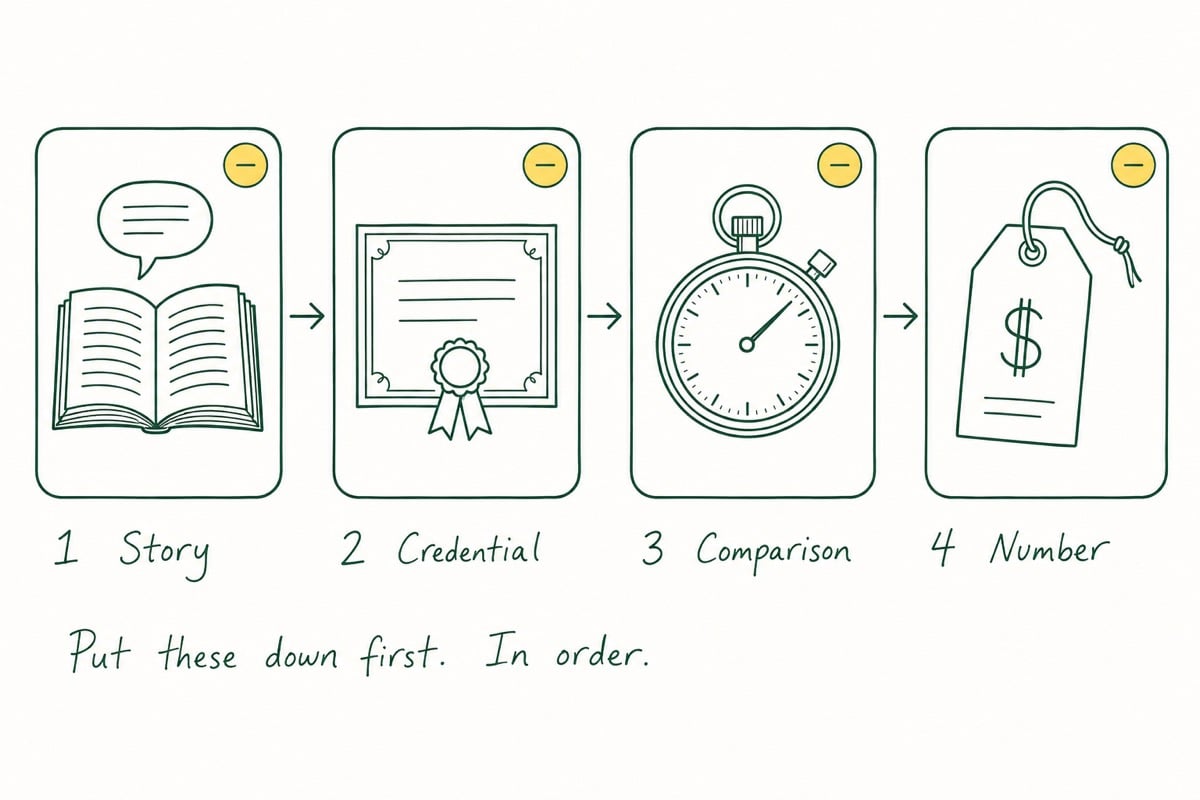
Put Down #1: The Story You've Been Telling About Your Career
The heaviest thing you carry is not your mortgage. It is the narrative. "I am the operations person." "I am the one who fixed the supply chain." "I am a lawyer." You have repeated some version of this at dinner parties for fifteen years, and other people have repeated it back to you until it hardened into fact.
The story is heavier than the credentials because it decides which options you let yourself even see. If the story is "I am a finance person," then anything that is not finance reads as a step down, a waste, or a midlife crisis. The story pre-filters the search before you have looked.
Putting it down does not mean trashing your past. It means noticing that the sentence you use to introduce yourself is a choice, not a law. Try the audit: write the one-line story you currently tell about your work. Then write the version you would tell if no one who knew the old you was listening. The gap between those two sentences is the size of the change you are actually considering.
Put Down #2: The Credential You're Afraid to Stop Signaling
The MBA. The title. The fifteen years at a recognizable company. The thing that took the longest to earn is the thing you are most afraid to stop signaling, which is exactly why it gets heavier the longer you carry it past its usefulness.
Here is the reframe that helps. Cal Newport's argument in So Good They Can't Ignore You is that what makes work valuable is "career capital," the rare and useful skills you have actually built, not the passion you bring or the labels you wear. [2] The skills are portable. The label often is not. When you change fields, the title from your last industry stops meaning anything to the new one, and the longer you wait for it to be honored, the longer you stall.
So separate the two. The capital you built is real and comes with you. The credential is a receipt for where you spent it, and a receipt is not the thing you bought. Put down the receipt.
Put Down #3: The Comparison to Your 30-Year-Old Self
Somewhere in the back of your head is a faster, hungrier version of you who could pull all-nighters and learn a new system over a weekend. You keep benchmarking against that person, and you keep losing, because you are measuring the wrong thing.
The midlife edge was never speed. It is judgment, and the research backs this more cleanly than most people assume. In tasks that draw on accumulated knowledge, what psychologists call crystallized intelligence, older workers actually perform measurably better than younger ones, even though employers routinely fail to recognize it. One controlled study found older workers answered more questions correctly on knowledge-based tasks while being valued no higher by the people hiring them. [3] Your raw processing speed dips. Your pattern recognition, the thing that lets you see in ten minutes what someone took ten years to learn, keeps climbing.
If you are in the harder version of this, the layoff or the health scare that forced the question, this is also where the brakes go. Do not decide this week. The comparison to your younger self creates urgency ("I am running out of runway"), and urgency is a bad co-pilot for an irreversible call. Stop racing a 30-year-old who no longer exists, and the timeline gets a lot more honest.
Put Down #4: The Income Number You Committed To in Your Last Negotiation
The number is the last thing you put down because it is the most real. A career change at 40 or 50 usually means a temporary dip, and the dip is survivable only if you have a floor under it. The mistake is treating the income you fought for in your last salary negotiation as a baseline you can never go below, even temporarily, even on purpose.
A note on the numbers: this article is about the operating mode of a career change, not about portfolio construction or specific investment decisions. If you are seriously planning a 12-to-24-month runway, talk to a fiduciary advisor (you can find a fee-only one through the NAPFA directory). What follows is the framework for thinking about runway, not the spreadsheet.
Think in months and ratios, not absolutes. How many months of fixed expenses can you cover before new income arrives? What can you move from fixed to flexible while you transition? The goal is a floor that lets you be wrong once without it becoming a crisis. Rebuild one system at a time, in the right order, and let the floor hold while you move everything above it.
What to Pick Up Instead: The Work That Reuses What You Already Know
Once the four things are down, the question is not "what is my passion." It is "where does twenty years of what I already know still apply, in a context I can actually stand?"
The pivots that hold are almost never clean jumps into something unrelated. They are sideways moves that carry your accumulated judgment into a new room. The operations leader who becomes a fractional COO for early-stage companies. The teacher who moves into instructional design. The engineer who shifts from building the thing to advising the people building it. We see the same shape in the goals our most engaged members write for themselves: "launch a profitable part-time coaching business," "transition from daily operations to strategic leadership." Both reuse a spent decade rather than discarding it.
The data on second-act work points the same way. In a survey of people who moved into purpose-driven "encore" careers later in life, more than seven in ten reported the new work was at least as satisfying as what came before, and over half found it less stressful than their previous job. [4] These were not people chasing a brand-new identity. They were people redeploying an old one.
The pivots that hold are the ones that reuse what you already spent twenty years learning.
This is also the cleanest way to tell a career change apart from burnout. If rest, a real break, and a lighter load would make the current work tolerable again, you may not need a new career yet. If you have rested and the answer is still "I am not burned out, I am done," that is the pivot signal.
Career Change at 40 vs. at 50: What Changes (and What Doesn't)
If you are reading this at 50 rather than 40, the bones of the problem are identical. You still put down the story, the credential, the comparison, and the number, in that order. You still pick up the work that reuses what you know.
Two things do change. The runway math gets tighter, because a pivot has fewer years to pay back, so the financial floor moves from "important" to "decisive." And energy becomes a planning input you cannot ignore, which usually argues for a bridge (part-time, advisory, a staged exit) rather than a cliff jump.
What does not change is how common this is among people serious about rebuilding. When we looked at the goals our most engaged LifeHack members set for themselves, career came up as the number one primary focus for roughly one in three, running dead even with family and relationships. A career change at midlife is not a fringe move or a crisis. For a large share of people, it is the modal rebuild, and the larger life-rebuild question it sits inside often touches the marriage and the meaning at the same time.
The 18-Month Northstar That Holds When the 5-Year Plan Breaks
Five-year career plans break in your 40s. Not because you are bad at planning, but because the version of you who would execute year four does not exist yet; she gets built by years one and two. Planning five years out assumes a stable self that a real change is specifically dismantling.
An 18-month Northstar holds where a five-year plan snaps. It is long enough to require a real pivot and short enough that you can actually see the terrain. Pick the one direction that reuses your capital, set a single concrete marker 18 months out, and let everything underneath it be experiments you are allowed to get wrong.
If you do one thing this week, do not quit anything. Write down the four things you would put down: the story, the credential, the comparison, and the number. Do not act on them yet. Just write them, and notice which one you flinched at. That flinch is where your career change actually starts.
You're not behind. You're at the rebuild.