

You searched "daily routine for 40 year old man" at an hour you would not admit to, probably after the third week of a plan that had already started to wobble. You know the pattern. The 5 a.m. alarm. The gym streak. The cold shower you read about somewhere. It holds for about three weeks, feels great, and then a brutal sprint at work or a kid home sick with a fever knocks the whole thing over, and you are back to coffee and good intentions.
Here is the first thing worth saying plainly. The problem is almost never that you do not know what to do. You have read the articles. You have owned the gym membership. The problem is that the routine you keep trying to run was designed for a body and a schedule you no longer have.
You Don't Need a Better Morning. You Need a Routine That Survives a Bad Day.
A 40-year-old man searching for a daily routine usually is not missing information. He is missing a routine that bends instead of snapping. The morning stacks and the optimization apps assume a clean, empty schedule and a body that bounces back overnight. Yours does not. You have a job that runs late, kids who do not care about your habit tracker, and a lower back that files a complaint most mornings before you do.
That is the real frustration. Not laziness. The gap between a routine built for a 25-year-old with nothing but time, and the loaded life you are actually trying to run it inside. When you were 28, a missed week was a shrug. Now a missed week turns into a missed month, and the month turns into that quiet voice at 2 a.m. asking when, exactly, you let yourself slide. The search is not really for tips. It is for a way to begin that does not collapse the first time real life leans on it.
Why the Old Playbook Stops Working at 40
The advice that worked at 25 stops working at 40 for a physical reason, not a character one. Recovery slows down. Muscle leaves quietly if you do nothing about it. Sleep gets lighter, and one bad night costs more than it used to. Stack a harder, longer routine on top of a slower-recovering body and you have built something that was always going to break the first busy week.
Look at what is actually happening under the hood. After about 30, men lose somewhere between three and eight percent of muscle mass per decade, and the slide speeds up the longer you ignore it [1]. That is not a reason to panic. It is a reason to stop training like the loss is not happening. The influencer morning routine, the all-or-nothing gym phase, the app that pings you at dawn, none of them were built around the one fact that matters most at your age: the body you are running this routine on is a different machine than the one in the videos.
Your Body Switched From a Performance System to a Maintenance System
Somewhere in your late 30s, the job of your daily routine quietly changed. At 25, the routine's job was to push a body that recovered no matter how badly you treated it. At 40, the job is to maintain and protect a body that now compounds small damage and small care in equal measure. Skip sleep for a week and you feel it for two. Train smart for a month and you feel ten years younger. The machine got more responsive to inputs, in both directions.
That one shift rewrites what a good routine even looks like. The mistake nearly every man makes is to design his routine around its best possible day. The perfect morning. The full 90-minute workout. The flawless meal prep. Then the first five-hour-sleep night arrives, the perfect day is impossible, so he does nothing, and "nothing" becomes the new default.
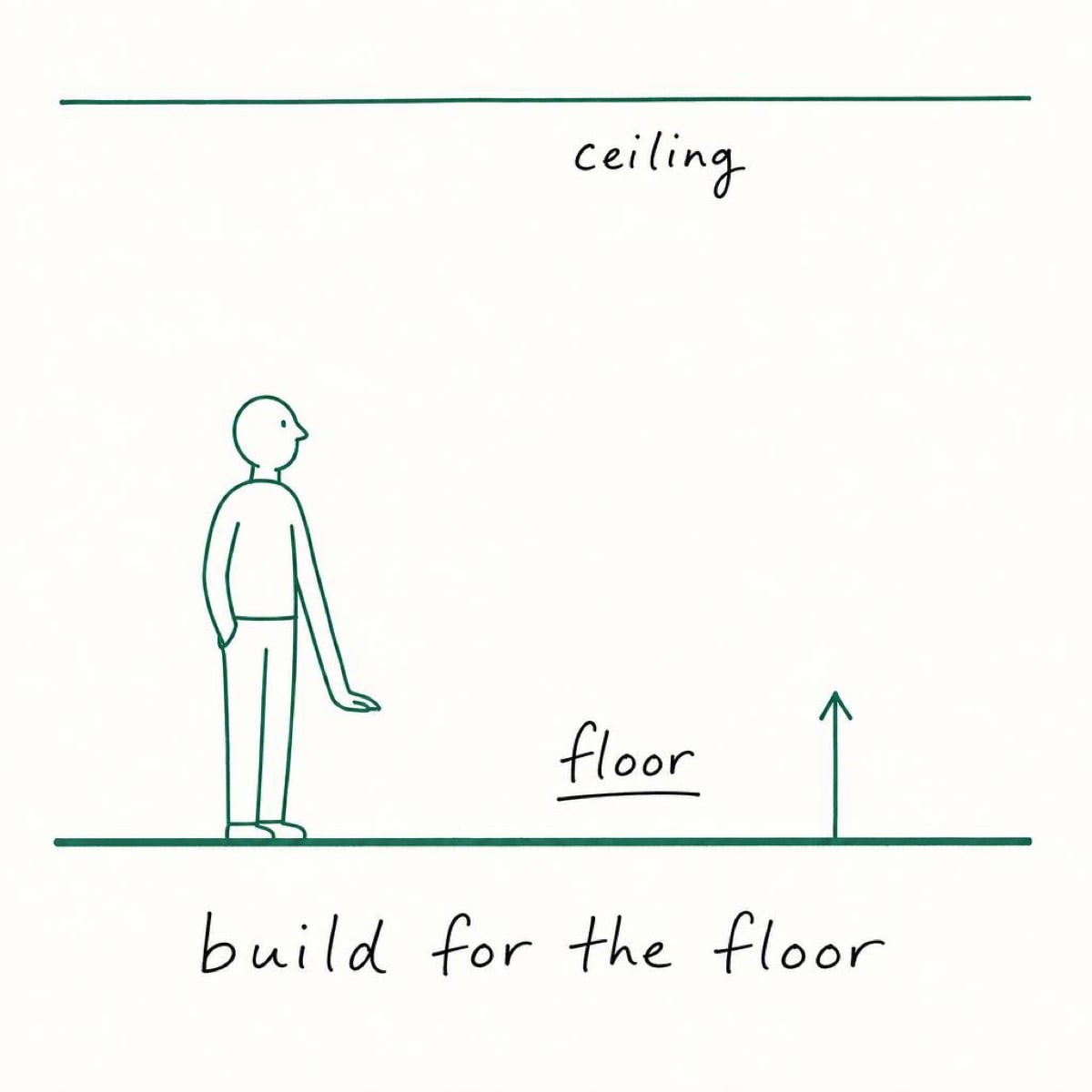
Flip it. Design the routine around its worst day instead of its best one. The win condition at 40 is not "optimize the perfect morning." It is "never miss twice." A single missed day does nothing. Researchers who tracked people building real habits found the median time to automatic was 66 days, with missing one day along the way making no measurable difference to whether the habit formed [2]. Streaks make you feel good and then make you quit, because the day the streak breaks feels like permission to stop. A routine you can shrink on a bad day and still keep is the one that is still running six months from now. That is the whole reframe. Build for the floor, not the ceiling.
How to Build a Daily Routine for a 40-Year-Old Man
A daily routine for a 40-year-old man should rest on four principles, in this order: protect recovery first, preserve muscle on purpose, anchor one keystone block you never skip, and define a floor version for bad days. The order matters. Recovery funds everything else. Muscle is the asset most men let quietly erode. The keystone makes the routine automatic. The floor keeps it breathing when life gets loud. Everything else is decoration.
Protect recovery first. Most men trying to rebuild are starting from depletion, not laziness, running on broken sleep and borrowed energy. So the evening matters more than the morning. The single highest-impact move is not the 5 a.m. alarm, it is a consistent sleep window. When researchers tracked nearly 61,000 adults with wearable data, the regularity of when people slept predicted death more strongly than how long they slept [3]. Same bedtime, same wake time, weekends included. A digital curfew an hour before bed does more for your routine than any morning hack. If you are running on empty before you even start, that is the first thing to fix, and we wrote about why you have no energy and the sleep habits worth protecting because almost every "I cannot stay consistent" story begins there.
Preserve muscle on purpose. This is the non-negotiable that men over 40 skip the most. Strength training two to three times a week is not about looking good at the beach. Grip strength alone is one of the sharpest predictors of how long you live: in a study of nearly 140,000 people, every five-kilogram drop in grip strength came with a 16 percent higher risk of death from any cause, a better predictor than blood pressure [4]. Lifting two or three times a week, even with sub-maximal weight, protects the muscle the years are trying to take. Pair it with protein spread across the day, not crammed into dinner. The research points to roughly 0.4 grams of protein per kilogram of bodyweight per meal, across three or four meals, to actually build and hold muscle [5]. That, not a magic morning shake, is the real engine behind every "30 grams of protein" rule you have seen.
Anchor one keystone block. Pick a single block you do at the same time every day, and let it pull the rest of the routine into place. For most men this is a ten-minute morning movement and mobility sequence, the thing a search for a daily stretching routine for men is really reaching for. It works because roughly 43 percent of daily behavior runs on autopilot, cued by context rather than fresh decisions, so one stable anchor quietly drags other good behaviors along behind it [6]. One block, same time, same trigger. Not twelve habits. One. Stacking the rest onto that anchor is exactly how habit stacking works, and the deeper mechanics are in how habits actually form.
Build the floor. Decide, in advance, what the routine shrinks to on your worst day. Traveling, sick, slammed at work: what is the fifteen-minute version you still do? A short walk, five minutes of mobility, a protein-forward meal, lights out on time. The walk matters more than it looks. Cardiorespiratory fitness tracks with survival so tightly that, in a study of over 120,000 people, the difference between the fittest and least fit rivaled the gap between a smoker and a non-smoker, with no upper limit where the benefit stopped [7]. A daily walk is the easiest floor there is, and it is also one of the most powerful things on the list. The floor is what makes the routine durable. It is the difference between a habit that survives a bad week and one that dies in it, which is the same problem we unpack in staying consistent when motivation runs out and why discipline beats motivation.
What a Realistic Day Looks Like (Not the Influencer Version)
In practice, a daily routine for a 40-year-old man looks far less heroic than the 4 a.m. cold-plunge version. It is four small protected blocks, not a two-hour production. Here is the full-effort day, with the floor day living underneath it for when everything goes sideways.
Take a man we will call Marcus, 43, two kids, a desk job, and a lower back that talks to him every morning. His full day is not complicated. Morning: a glass of water, ten minutes of mobility before anyone else is awake, and a breakfast built around thirty grams of protein. Midday: a fifteen-minute walk after lunch and two or three breaks where he stands up and moves instead of marinating in his chair. Late afternoon or early evening, three days a week: a forty-minute strength session, joint-friendly, never to failure. Evening: screens off by 9:30, same bedtime as last night.
Now the part that makes it hold. On the day his youngest is up vomiting at 3 a.m. and a deadline lands at 9, Marcus does not run that day. He runs the floor: the walk, five minutes of mobility, a protein-forward meal, and the same bedtime. Fifteen minutes total. Nothing impressive. But the routine did not break, so there is nothing to restart tomorrow. The streak chasers spend January rebuilding from zero. Marcus has just been quietly running, bending on the hard days, for the better part of a year.
A year in, none of this looks like a transformation montage. The back still complains some mornings. But he is stronger than he was at 39, he sleeps through the night, and the energy that used to vanish by 3 p.m. is mostly still there at dinner, which is the part that matters, because that recovered energy is what funds everything else he wants to rebuild: the work, the money, the time with his kids. The daily routine is not the whole life. It is the keystone the rest of the life gets built on. If you want the full five-domain version of that rebuild, we mapped it in what a midlife reset actually involves.
"I've Tried Routines Before and They Never Stick"
That objection is fair, and it usually has one cause: you built for the ceiling, so the first bad week ended the whole thing. Building for the floor is the specific fix, not more willpower. But two other doubts come up almost every time, and they deserve real answers.
"I do not have time." You have fifteen minutes, because that is all the floor version asks for. The routine scales up on good days and shrinks on bad ones, and the floor is the part that never moves. Most men who think they have a time problem actually have a ceiling problem: they only counted the perfect two-hour version, decided it was impossible, and did nothing.
"My back and knees already hurt." Then the routine starts mobility-first and keeps strength sub-maximal, which is what this body needs anyway. Pain that lingers or sharpens is a signal to get it checked by a professional before you train through it, not something a morning routine should override. Build around the body you have, not the one in the video.
Where to Start This Week
Do one thing this week. Not five. Pick the single keystone block that, if it ran every day, would make the rest easier, almost always a short morning movement anchor or a fixed sleep window. Then write its floor version, the fifteen-minute one you can do on your worst day. Protect just that for eight weeks before you add anything else.
The best daily routine for a 40-year-old man is not the most impressive one. It is the one that bends on the hard days and is still running six months from now. Build the floor first. Everything else stacks on top of it.