

So you think that you’re a rational person and that those psychological tricks that work on the masses won’t work on you? Well, the following infographic might shake your confidence.
Interestingly enough, the brain often likes playing tricks on us, whether we want it to or not. Before we get into the infographic, let me introduce you to some of the main cognitive biases upon which these tricks are based.
Unfortunately, reports that the medicine might be ineffective arose, and Mr. Wright’s health suddenly deteriorated when he learned of this. His doctor noticed the pattern and decided to administer placebo injections consisting only of water while telling Mr. Wright that the injections contained a new and improved version of the medicine.
Mr. Wright’s health improved dramatically while taking the placebo. Sadly, the American Medical Association ultimately announced that Krebiozen was completely ineffective in the treatment of cancer. Mr. Wright resultantly lost hope and died within a few days of this revelation.
Now that you’re familiar with the most common cognitive biases, check the infographic below for more information. Are there any that have tricked you recently?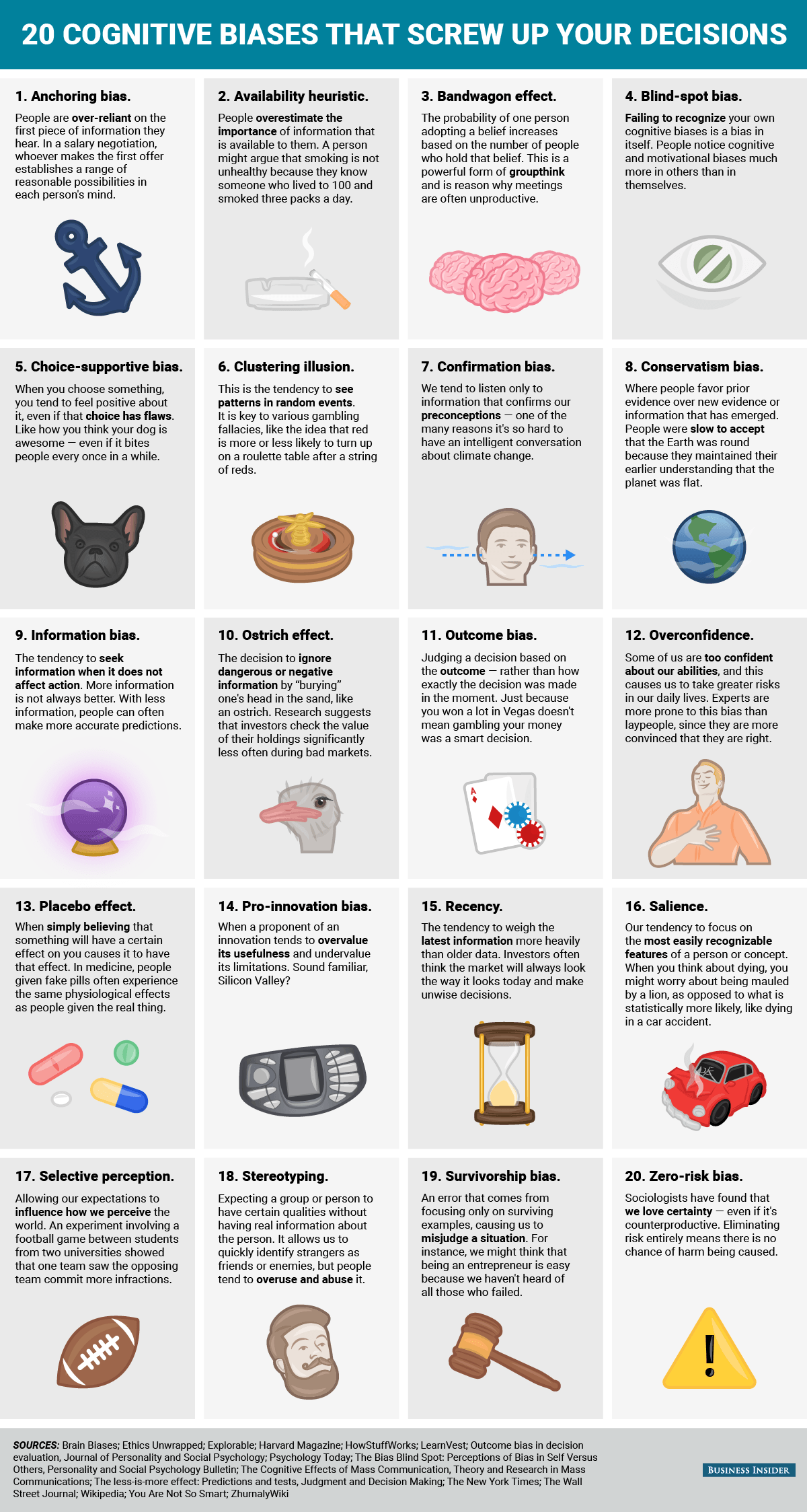
Interestingly enough, the brain often likes playing tricks on us, whether we want it to or not. Before we get into the infographic, let me introduce you to some of the main cognitive biases upon which these tricks are based.
Anchoring
When making decisions, we tend to rely too heavily on the first piece of information we receive. This fact is often exploited in marketing, particularly online. How many times have you come across something along these lines: "Buy this new product, which is normally priced at $299 for a limited-time price of $49!" That's a phenomenal bargain, right? Once your brain is anchored to a price of $299, the $49 you might have balked at before sounds much cheaper. How often are you being anchored in your daily life?Confirmation Bias
We tend to look for information that confirms what we believe. This is referred to as confirmation bias, and is precisely what gets us mired in our current beliefs. Our minds seek information that supports what we think, so it is hard to adopt new thoughts and beliefs. Conspiracy theorists are a perfect example of this. They often twist facts and disregard that which challenges their theories. They seek evidence that confirms their assumptions and, sure enough, they manage to find plenty of it. That said, not every conspiracy theory is automatically wrong.Placebo Effect
If you believe in something strongly enough, it may enter reality to a certain extent. The most famous example of the placebo effect is arguably the case of Mr. Wright, a terminally ill patient who had been given less than 2 weeks to live. The release of a new drug called Krebiozen gave him hope, and his health improved rapidly upon taking the drug.Unfortunately, reports that the medicine might be ineffective arose, and Mr. Wright’s health suddenly deteriorated when he learned of this. His doctor noticed the pattern and decided to administer placebo injections consisting only of water while telling Mr. Wright that the injections contained a new and improved version of the medicine.
Mr. Wright’s health improved dramatically while taking the placebo. Sadly, the American Medical Association ultimately announced that Krebiozen was completely ineffective in the treatment of cancer. Mr. Wright resultantly lost hope and died within a few days of this revelation.
Clustering Illusion
This is the tendency to see patterns in random events that are not truly related. Our mind is designed to spot patterns everywhere, even when there is no scientific evidence for them. Take sports, for instance. Sports fans often think that they can predict the success or failure of their favorite player. If they see LeBron scoring multiple free throws in a row, they start to think that he will make the next shot as well. In reality, research has shown that there is little to no link between any of the free throws, even when they occur successively.Survivorship Bias
Survivorship Bias occurs when we fail to adequately consider failure rates when making decisions. There are scores of entrepreneurs who failed, painters who died in poverty, and inventors who were never successful, but how often do we hear their stories? Rarely, because nobody likes to hear stories that end in failure. Such stories can be sad and depressing, but they are part of reality. Have you ever experienced Survivorship Bias in your life?Now that you’re familiar with the most common cognitive biases, check the infographic below for more information. Are there any that have tricked you recently?