A shoebox full of receipts seem to be the norm for most of us, whether or not we manage our money online. Every time we make a purchase, we shove receipts in wallets, pockets or purses. We bring them home, sometimes sort
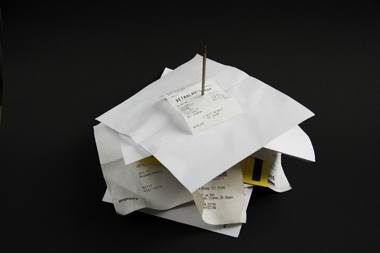
A shoebox full of receipts seem to be the norm for most of us, whether or not we manage our money online. Every time we make a purchase, we shove receipts in wallets, pockets or purses. We bring them home, sometimes sort them and drop them into a shoebox. From there, we ignore them until tax time — often even longer. But we don't actually need most receipts. While some we may need to hold on to for taxes or records, the grand majority can be out of your house within a week.
Short-Term Keepers
Receipts tend to fall into two categories: those you need to keep at least long enough to double check them against your purchases when you get home and those you need to hold on to for a bit longer. The short-term keepers can be thrown away as soon as you've taken care of checking them — I tend to shred these sorts of receipts, but many don't have any sort of information you really need to worry about.
Cash Receipts: If you keep track of where you spend your cash (as opposed to using a debit or credit card), you may need to note any receipts for cash spending on your money management software. After that, you can get rid of it.
Clothing Receipts: Once you've put on an outfit and taken off the tags, you can generally get rid of the receipt.
Restaurant Receipts: It's generally worth keeping receipts from restaurants at least long enough to check them against your card statement if you left a tip on your card. There is a chance that the tip can be altered or misread, and you'll need your receipt to dispute it. If everything checks out, and your meal wasn't a business expense, you can trash the receipt.
There is a school of thought that you should keep a receipt until you get rid off whatever you purchased — for instance, you should hold on to a receipt from the grocery store until you finish off your gallon of milk. That's because you can get reimbursements in many situations (like recalls) or may need to take the item back. It comes down to your personal choice just how long you want to keep receipts for things like groceries and gas, but generally, less than a month seems like a good choice. Otherwise, though, most personal expenses aren't even short-term keepers. Your grocery receipt may not even need to make it out of the store's door with you.
Long-Term Keepers
There are some receipts you may need to hold on to significantly longer than the month it takes for your card statement to arrive. Receipts can be used as proof of a whole list of different things, from tax deductions to warranties, so you'll need to hold on to a few receipts. I know many people that scan these important receipts to make sure that they have them handy. The IRS does accept scanned receipts, but if you're trying to work with a credit card company or insurer, you may need to hang on to the original.
Business Expenses: If you own your own business, most expenses are tax deductible. Hold on to those receipts, though — in the event of an audit, they come in handy. That includes some receipts you might otherwise get rid of, like gas or meals, as long as they are business expenses.
Job Search Expenses: You can deduct many of the expenses associated with a job search, so hold on to those receipts.
Employer Reimbursement: With most companies, you'll need the receipt for any expense you're reimbursed for. It's generally worth making a copy to hold on to until you actually get a check — you'll likely have to turn the original over to your employer.
Medical Expenses: Between tax deductions and insurance, holding on to any receipts for medication, doctors' visits and procedures is a must.
Big Purchases: Hold on to the receipts for big purchases, like appliances and electronics. Defining how big can be tricky, but consider how you paid for it — if you used a credit card, you may have a warranty beyond what the store offered you, as long as you have the original receipt. You may also need receipts for big ticket items in order to make an insurance claim.
Warranties: If you purchase any product with a warranty, you'll want to keep the receipt — you may need it to claim the warranty or even prove that you have it. When possible, it makes sense to keep warranty receipts together with the product that they came with. Taping them inside owners' manuals can be an easy way to keep track of them.
Donations: It often takes an extra step to get a receipt for a donation — but it's worth it. You'll need it if you want to write your donation off on your taxes.
Just how long you need to keep receipts for depends on just who might ask to see them. A good rule of thumb is that anything related to insurance or warranties can be thrown away once you get rid of the item in question — if you replace your stove, for instance, you'll want to keep the new receipt, but you can throw away the receipt for the old appliance. For the IRS, how long you need to keep receipts can vary significantly: the very longest you might need a set of receipts is seven years.
Don't want to binge shop? Now you can organize better so you don't have to! Here are 9 ways to organize your wardrobe to save money!
🧭
Score Your Life Rebuild in 9 Questions
Something is off, and the hard part is that it is never obvious which part of life is causing it. Find out which Aspect is most depleted right now and what to do about it this week.
🧭
Which Aspect
Where the drain is
⏳
Your Block
One defended hour
🌱
The Mode
What holds long-term
Your 9-question Life Rebuild Score reveals:
✓ Which of the 6 Aspects of your life is most depleted right now
✓ Why fixing the loudest problem first usually fails
Something is off, and the hard part is that it is never obvious which part of life is causing it. The Life Rebuild Score tells you which of the six Aspects of your life is taking the hit, and the one thing to defend this week.
Rebuild the Life You Actually Want, One System at a Time
Get the weekly Life Rebuild essay. One operating-mode shift each week across work, health, money, relationships and meaning.
↓ Plus The Defended Hour, a one-page worksheet for protecting one hour a week against everything else.
Free. Unsubscribe anytime. One email a week, no filler.
One quick question
What's closest to where you are right now?
Pick one and we'll show you the best place to start.
Free · no signup to see your match
You said:
Your best next step
Take the Life Rebuild Score
Something is off, and the hard part is that it is never obvious which part of life is causing it. The Life Rebuild Score tells you which of the six Aspects of your life is taking the hit, and the one thing to defend this week.
The weekly Life Rebuild essay, plus The Defended Hour worksheet the moment you join.
Free. Unsubscribe anytime.
Or try:
Two ways to start
Where do you want to begin?
Find out where you stand
Which Part Actually Needs Fixing?
Something is off, and the hard part is that it is never obvious which part of life is causing it. The Life Rebuild Score tells you which of the six Aspects of your life is taking the hit, and the one thing to defend this week.

 A shoebox full of receipts seem to be the norm for most of us, whether or not we manage our money online. Every time we make a purchase, we shove receipts in wallets, pockets or purses. We bring them home, sometimes sort them and drop them into a shoebox. From there, we ignore them until tax time — often even longer. But we don't actually need most receipts. While some we may need to hold on to for taxes or records, the grand majority can be out of your house within a week.


